BMI, BMR, TDEE, FFMI & Natty Limit Calculator
One free tool to measure your body composition, estimate your daily calorie needs, and find your drug-free muscle-building ceiling in metric or imperial units.
Got your TDEE? Track your daily calories and import it directly →
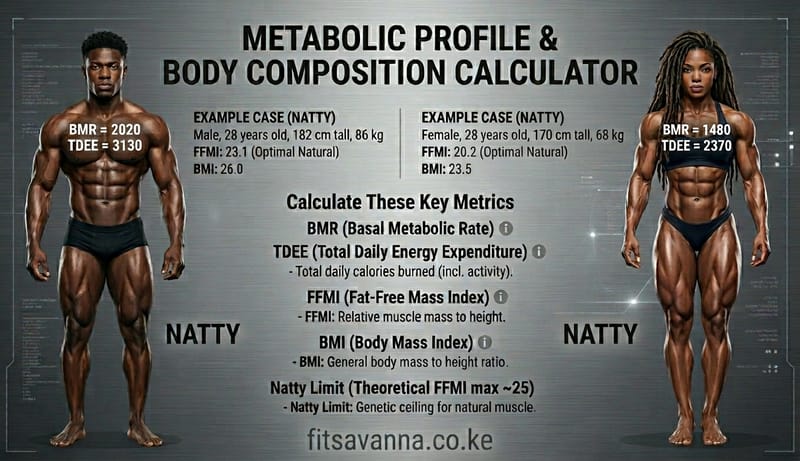
What each metric means
Body Mass Index
A quick screening ratio of weight to height squared. Useful for population-level health trends but blind to muscle mass. A lean 90 kg athlete and an unfit person of the same height will score identically.
Basal Metabolic Rate
Calories burned at complete rest. Calculated here via Katch-McArdle using lean body mass, which makes it more accurate than height/weight formulas for people who know their body fat percentage.
Total Daily Energy Expenditure
Your true daily calorie burn once activity is factored in. Eat at TDEE to maintain weight, below it to lose fat, or slightly above it to build muscle without excessive fat gain.
Fat-Free Mass Index
Like BMI but calculated on lean mass only. A normalized FFMI above roughly 25 for men or 22 for women is rare among natural athletes and is used as a reference point in drug-free physique discussions.
Example results
How to use this calculator
Enter your stats
Input your sex, age, height, weight, and estimated body fat percentage. If you do not know your body fat, a DEXA scan or trained calipers give the most reliable figure. Rough visual estimates are fine for a ballpark result.
Select your activity level
Be honest. Most people overestimate activity. If you train 3 days a week but sit at a desk the rest of the time, choose Light or Moderate. Overestimating TDEE is one of the most common reasons people plateau on a supposed deficit.
Read your calorie targets
The results page shows maintenance calories, a 500 kcal/day deficit for fat loss, and a 300 kcal/day surplus for lean muscle gain. The smaller surplus keeps fat gain minimal while still fuelling muscle protein synthesis.
Try the Natty Limit tab
Switch to the Natty Limit tab and enter your wrist and ankle circumference (bone, not skin). Optionally add six muscle measurements to unlock body part natural maximums. The result shows how far you are from your estimated drug-free ceiling.
Frequently asked questions
How do I calculate my BMI?
BMI (Body Mass Index) is your weight in kilograms divided by your height in metres squared. For example, a person who is 70 kg and 1.75 m tall has a BMI of 70 divided by (1.75 x 1.75), which equals 22.9. In imperial units, divide your weight in pounds by your height in inches squared, then multiply by 703. The calculator on this page does all of that automatically.
What is a healthy BMI?
For adults, the standard WHO ranges are: underweight below 18.5, healthy weight 18.5 to 24.9, overweight 25 to 29.9, and obese 30 or above. These thresholds apply to most populations, though some health bodies use slightly lower cut-offs for people of Asian descent. BMI is a screening tool, not a diagnosis. A very muscular person may score as overweight while carrying very little body fat.
How do I calculate my BMI in kg?
Divide your weight in kg by your height in metres squared. Formula: BMI = kg divided by m squared. If your height is in centimetres, convert first by dividing by 100 (e.g. 170 cm = 1.70 m). Our calculator accepts kilograms and centimetres directly so no manual conversion is needed.
What is the BMI for 170 cm and 70 kg?
At 170 cm (1.70 m) and 70 kg, your BMI is 70 divided by (1.70 x 1.70), which equals 24.2. That sits squarely in the healthy weight range of 18.5 to 24.9.
Does BMI change with age?
The standard BMI formula does not change with age for adults. However, body composition does shift with age. Older adults tend to carry more fat and less muscle at the same BMI. Some clinicians apply age-adjusted interpretations, particularly for people over 65. This calculator shows your raw BMI and lets you factor in body fat percentage via the FFMI tab for a more complete picture.
What is the meaning of BMR?
BMR stands for Basal Metabolic Rate. It is the number of calories your body burns at complete rest: the minimum energy required to keep your heart beating, your lungs breathing, and your organs functioning. It is the baseline floor of all calorie planning.
Should I eat my BMR to lose weight?
Generally no. Eating exactly at BMR means eating as if you were in a coma. It ignores every calorie you burn through movement, digestion, and daily activity. Most people should eat at or slightly below their TDEE (BMR multiplied by an activity factor) to lose fat while preserving muscle. Eating only at BMR for extended periods can slow your metabolism and cause muscle loss.
What is the difference between BMI and BMR?
BMI (Body Mass Index) is a ratio of weight to height used to screen for under- or overweight status. BMR (Basal Metabolic Rate) is a daily calorie figure showing how much energy your body burns at rest. BMI tells you roughly where you sit on a weight scale; BMR tells you how much fuel your body needs to survive. Both are inputs for body composition planning, but they measure entirely different things.
What is a good BMR for my age?
BMR varies widely by body size, sex, and lean mass, not just age. A rough reference: adult women typically range from about 1,200 to 1,600 kcal per day and adult men from about 1,500 to 2,200 kcal per day. BMR declines gradually with age as muscle mass decreases, roughly 1 to 2% per decade after 30. Resistance training is the most effective way to maintain a higher BMR as you age. Use this calculator with your own stats for a personalised figure.
What does TDEE mean?
TDEE stands for Total Daily Energy Expenditure. It is the total number of calories you burn in a day, accounting for your resting metabolism (BMR) plus all physical activity including exercise, walking, standing, and even digesting food. Eating at your TDEE keeps your weight stable.
What is my TDEE when my BMR is 1,400?
It depends on your activity level. A BMR of 1,400 kcal per day multiplied by standard activity factors gives: sedentary (desk job, no exercise) roughly 1,680 kcal, lightly active (1 to 3 days per week exercise) roughly 1,925 kcal, moderately active (3 to 5 days per week) roughly 2,170 kcal, and very active (6 to 7 days per week of hard training) roughly 2,415 kcal. Use the calculator above with your actual stats for a precise figure.
How do I know what my TDEE is?
The most practical method is to calculate it using a formula (BMR multiplied by an activity factor, as this tool does), then track your actual weight for 2 to 3 weeks while eating a consistent number of calories. If your weight is stable at 2,200 kcal per day, your real-world TDEE is approximately 2,200 kcal. Calculators give a good starting estimate; your own data refines it.
How much TDEE is good?
TDEE is not something to maximise or minimise. It is a measurement, not a goal. A higher TDEE generally means you are more active and can eat more while staying lean, which is a health advantage. The goal is to understand your TDEE so you can eat the right amount relative to it: at TDEE to maintain, below it to lose fat, or slightly above it to build muscle.
What does FFMI mean in fitness?
FFMI (Fat-Free Mass Index) is a measure of how much lean muscle mass you carry relative to your height. It is calculated as lean body mass (kg) divided by height (m) squared. Unlike BMI, FFMI removes fat from the equation entirely, making it a far more useful metric for anyone who lifts weights.
What is a good FFMI score?
For men, an FFMI of 18 to 20 is average for a non-training adult, 20 to 22 is above average, 22 to 24 indicates serious training, and above 25 is considered near or at the natural ceiling. For women, natural elite athletes typically fall between 16 and 19. A normalized FFMI above 25 for men is rare enough in drug-tested competition that it is used as a rough threshold in natty limit discussions.
What is a natural FFMI?
Research by Kouri et al. (1995) found that steroid-free competitive bodybuilders rarely exceeded a normalized FFMI of 25. This is widely cited as the approximate natural ceiling for men, though genetics vary. Some exceptional naturals reach 25 to 26; most will peak between 22 and 24 with years of dedicated training. For women, the natural upper range is roughly 20 to 22.
How long does it take to reach an FFMI of 22?
For a man starting from an average FFMI of around 19 to 20, reaching 22 typically requires 3 to 5 years of consistent, progressive resistance training combined with adequate protein intake and sleep. Progress is fastest in the first 1 to 2 years and slows significantly as you approach your genetic ceiling. An FFMI of 22 represents a genuinely impressive, above-average physique.
What is the natural (natty) limit in bodybuilding?
The natty limit refers to the maximum amount of muscle mass a person can build without the use of performance-enhancing drugs. It is not a fixed number. It varies by height, bone structure, genetics, and training age. Models like the Casey Butt formula estimate it using wrist and ankle circumference as proxies for skeletal size, since larger bones can anchor more muscle.
Is there such a thing as a natty limit?
Yes, physiologically. Muscle hypertrophy is ultimately constrained by the number and size of muscle fibres, which are partly determined by androgen receptor density and satellite cell activity, both strongly influenced by genetics. Drug-free athletes have lower anabolic hormone levels and slower recovery than enhanced athletes, creating a real ceiling. The debate is not whether the limit exists, but exactly where it sits for any given individual.
What qualifies as natty (natural)?
In the context of bodybuilding and fitness, "natty" means training without anabolic steroids, growth hormone, SARMs, or other performance-enhancing drugs. In tested federations like WNBF or INBA/PNBA, athletes must pass drug tests and observe substance ban periods. Creatine, protein supplements, caffeine, and legal vitamins are universally considered natural.
What is a natural FFMI limit?
The most widely cited research-backed natural FFMI limit is approximately 25 for men (normalized to 1.80 m height) and around 20 to 22 for women. The Casey Butt formula used in our Natty Limit tab personalises this based on your wrist and ankle measurements, giving a more individual estimate than a population-wide ceiling.
What is a 21 FFMI physique?
An FFMI of 21 for a man represents a lean, visibly muscular physique, typically someone with developed shoulders, chest, and arms who is clearly athletic. Think of a fit recreational lifter with 2 to 4 years of consistent training. It is above average but well within natural reach for most people who train seriously. At 1.80 m and 10% body fat, FFMI 21 corresponds to roughly 82 kg bodyweight.
Which BMR formula does this calculator use?
This calculator uses the Katch-McArdle formula, which calculates BMR from lean body mass rather than total weight. This makes it more accurate than the older Harris-Benedict formula for people who know their body fat percentage, because it is not skewed by how much fat you carry.
How accurate is the natty limit estimate?
The Casey Butt formula is a statistical model derived from measurements of elite natural bodybuilders. It reflects the upper boundary that genetically gifted naturals have historically achieved, not a guaranteed personal ceiling. Treat it as a useful reference point. Factors like training age, sleep quality, nutrition precision, and individual hormone levels all affect where you personally plateau.
How do I calculate my BMR?
The most accurate method for people who know their body fat percentage is the Katch-McArdle formula: BMR = 370 + (21.6 × lean body mass in kg). Lean body mass is your total weight minus fat weight. For example, a person weighing 75 kg at 20% body fat has 60 kg of lean mass, giving a BMR of 370 + (21.6 × 60) = 1,666 kcal. If you do not know your body fat, the Mifflin-St Jeor formula uses height, weight, age, and sex instead. The calculator on this page uses Katch-McArdle automatically once you enter your body fat percentage.
What is a good BMR for weight loss?
BMR itself is not a weight loss target - it is a measurement. What matters for weight loss is eating below your TDEE (your BMR multiplied by an activity factor). A common starting point is a 500 kcal daily deficit below TDEE, which produces roughly 0.5 kg of fat loss per week. Eating at or below your BMR is not recommended for sustained fat loss as it risks muscle loss and metabolic adaptation. Calculate your TDEE first, then apply a moderate deficit from there.
Page last updated: