Kombucha in Kenya: Where to Buy, How to Brew, Risks, and Benefits
Kombucha is the easiest probiotic drink you can make at home. Here is where to buy it in Kenya, how to brew your own, what the risks are, and what the science actually says about its benefits.
Unlike kefir or homemade yoghurt, kombucha is, in my experience, the most forgiving fermented drink you can make at home.
With kefir, you can blink and find the entire batch has curdled into a watery mess. With yoghurt, one hygiene mishap or temperature overshoot and everything goes to waste in an instant.
With kombucha, however, as long as you have the culture, the drink practically makes itself.
Ever since I learned to make kombucha, I've put kefir and yoghurt on pause, and haven't looked back.
If you've yet to taste kombucha, it is a slightly fizzy, tangy, and naturally sweet drink; I'd say it sits somewhere between sweetened mead (pombe ya asali) and apple cider vinegar, but far more pleasant than that sounds.
It's not as probiotic-dense as kefir, and it lacks yoghurt's versatility (you can't turn it into Greek Yoghurt, labneh, or skyr), but as a low-calorie, dairy-free, genuinely enjoyable drink, it holds its own.
If you're curious whether it's worth adding to your routine, here's everything you need to know.
Where Can You Buy Kombucha in Kenya?
There are several retailers of kombucha locally, with prices ranging from KES 200 to KES 500 per 500ml.
Carrefour
Carrefour is the most accessible starting point. They stock several brands, including Mohawk and Booch, and their online store is generally the cheapest delivery option. Prices online match in-store, and their physical locations are now spread across most major towns locally. Note that online orders require a KES 1,000 minimum, with free shipping kicking in at KES 4,000.
Zucchini
Zucchini operates both physically and online but has a narrower selection than Carrefour (mostly Mama Kombucha brand). Delivery is a flat KES 200 with a KES 1,000 minimum order. The bigger limitation is availability; they focus on upscale Nairobi areas like Westlands and have been scaling back, having recently closed their Garden City branch along Thika Road.
Kombucha Kenya
Kombucha Kenya consistently offers the best value locally. A one-litre bottle goes for KES 400, which is what most other retailers charge for 500ml. There is no minimum order, and while shipping runs KES 250, you are already saving significantly on the product itself. They brew their own kombucha, so there is no brand variety, but they compensate with the widest flavour selection of any retailer listed here.
Greenspoon
Greenspoon is a solid option if brand variety matters to you, with a selection comparable to Carrefour. The tradeoff is price; products tend to cost slightly higher than other retailers. There is no minimum order, but free shipping only kicks in at KES 5,000.
TikTok Sellers
If you want to skip mainstream retailers altogether, several independent brewers advertise on TikTok. Prices can be competitive, but without a formal storefront, recourse is harder if something goes wrong.
For the best value, Kombucha Kenya is hard to beat. For brand variety, Carrefour or Greenspoon are your safest bets.
How Do You Make Your Own Kombucha at Home?
As I mentioned earlier, kombucha is the easiest probiotic drink you can make at home. That said, you need a starter culture to get going, known as a SCOBY (Symbiotic Culture of Bacteria and Yeast).
Getting Your SCOBY
The simplest way to obtain a SCOBY is to grow one from a store-bought kombucha. It has to be original flavour; unflavoured varieties work best because starting with a flavoured culture limits how you can flavour your own brew later.
To grow your SCOBY, brew a litre of strong, sweet black tea. Be generous with the sugar; the yeast feeds on it, while the Acetic Acid Bacteria (AAB) feeds on the tea itself. Let the tea cool to under 30 degrees Celsius (or room temperature) before proceeding, as higher temperatures will kill the cultures.
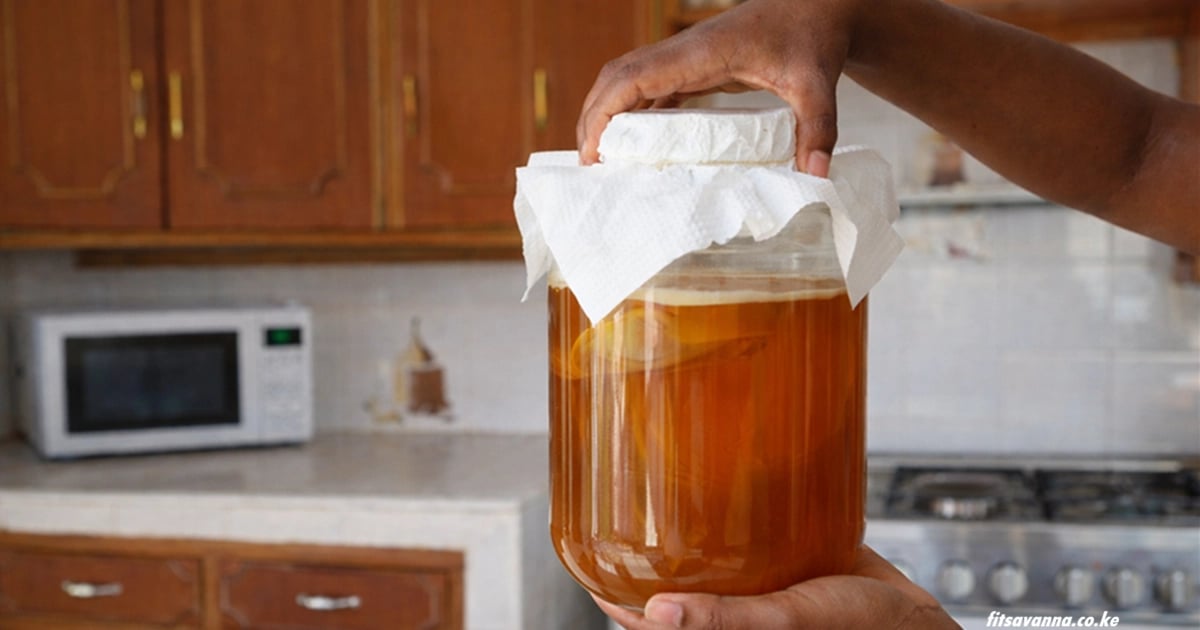
Pour the cooled tea into a glass jar, add your store-bought kombucha, and seal the opening with a breathable cover such as a kitchen cloth or paper towel secured with a rubber band. Do not use an airtight lid.
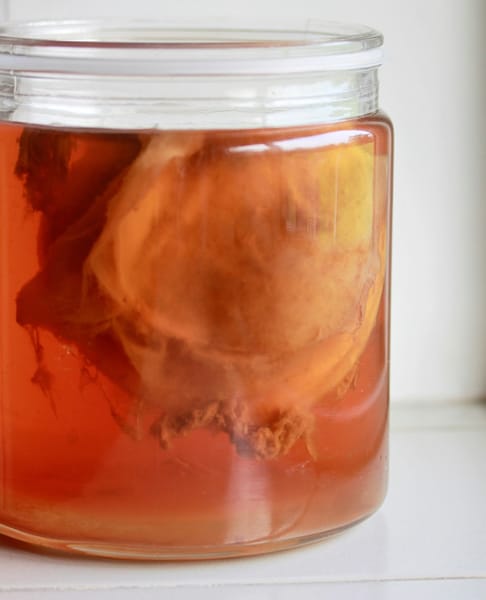
Leave it for 3 to 5 weeks depending on room temperature. You will know the SCOBY is ready when a gel-like disc forms and floats near the surface. It looks unusual, but that is exactly what you want.
A SCOBY culture forming in a glass jar during kombucha fermentation | Photo: Megumi Nachev
Brewing Your Kombucha
Once your SCOBY is ready, you can use it to brew kombucha indefinitely. The liquid used to grow it is drinkable but tends to be quite vinegary, so most people discard it.
To brew, place your SCOBY in a clean glass jar, add freshly brewed sweet black tea cooled to under 30 degrees, cover it the same way as before, and leave it for around 5 days. The longer you leave it, the more acidic and vinegary it becomes, so taste it along the way and stop when it suits you.
When ready, pour it out and enjoy. If you are not brewing another batch immediately, store your SCOBY in the fridge or freeze it until you are ready again.
What Are the Risks of Kombucha?
Kombucha is not without risks, and most of them stem from how it is prepared.
Kombucha also naturally contains small amounts of alcohol due to the presence of yeast and sugar. An FDA (US) investigation, as reported by the CDC, found alcohol content ranging from 0.7% to 1.3%.
For these reasons, kombucha is generally contraindicated in pregnant women, mainly due to its alcohol content and the theorised presence of heparin-like compounds (glycosaminoglycans) that may be produced in the body in response to kombucha consumption, posing potential blood-thinning risks in the third trimester.
As for gastritis specifically, proceed with caution: there is no solid evidence that kombucha improves the condition, and its acidity may not agree with an already irritated stomach lining.
If you are not immunosuppressed or pregnant, and your kombucha was prepared hygienically, you would need to consume significant amounts for it to cause harm.
With that said, kombucha offers several well-documented benefits, especially for gut health.
Kombucha brewed from green tea has also been found to exhibit antibacterial activity against pathogens including Salmonella, E. coli, Staphylococcus aureus, and Listeria monocytogenes, alongside antiproliferative activity against cancer cells.
That said, nearly all these benefits are currently based on in vitro (test tube) and in vivo (animal) studies. Human clinical trials remain limited, so temper your expectations accordingly.
So, is Kombucha Worth It?
For most healthy people, yes. It is an enjoyable, low-calorie drink with a genuinely interesting flavour profile, and the gut health benefits, while mostly limited to animal studies so far, are promising enough to make it worth trying.
The risks are real but largely avoidable. Use glass jars, do not overferment, and keep your brewing environment clean. If you are pregnant or immunosuppressed, skip it entirely.
If you are on the fence, start by buying a bottle from Kombucha Kenya or Carrefour before committing to brewing your own. At KES 200 to KES 400, it is a cheap experiment. If you like it, the SCOBY is your next step, and from there the cost drops dramatically.
I switched from kefir and yoghurt to kombucha, and I think this is the fastest, lowest-risk way to get your daily probiotics. Whether you do the same is ultimately a matter of taste, literally.
If you do decide to track it, we have added kombucha to our food tracker using USDA data.
Medical Disclaimer:The information provided in this article is for informational purposes only. It does not constitute medical advice, diagnosis, or treatment. Always consult a qualified health provider before making changes to your diet or health routine.


Join the conversation!
Share your thoughts on “Kombucha in Kenya: Where to Buy, How to Brew, Risks, and Benefits” below.