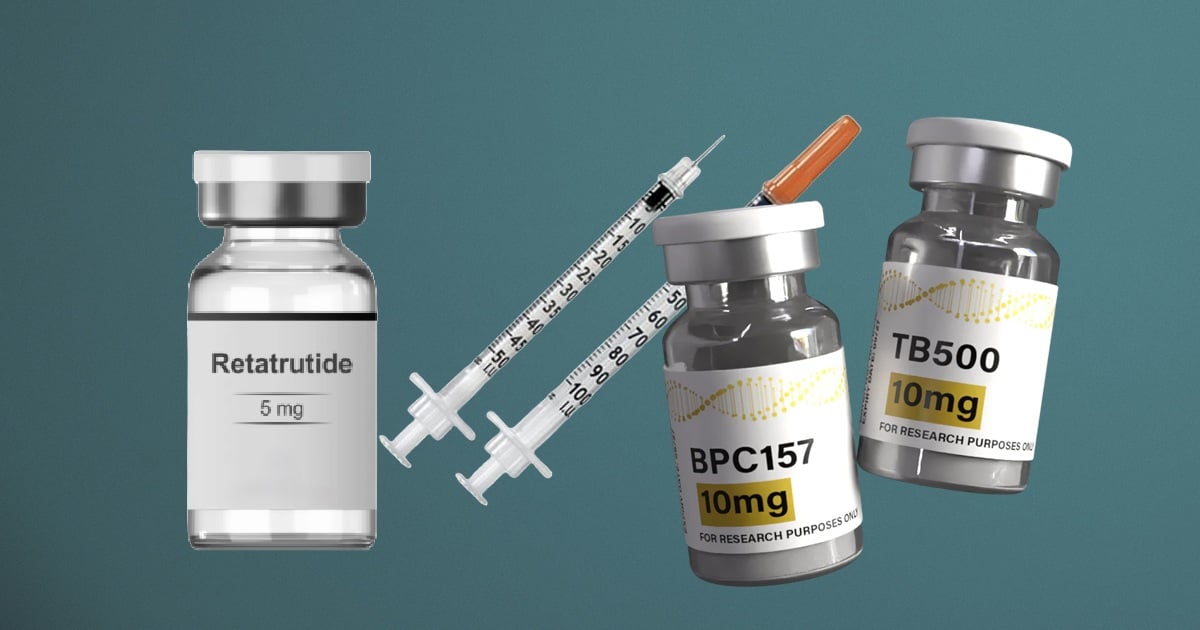
If you're into fitness, you've probably heard about fat-loss and recovery peptides like retatrutide, BPC-157, TB-500, and other compounds now circulating widely on social media.
You may have even considered using them yourself, perhaps to speed up recovery from that stubborn elbow pain so you can bench two plates again, or to accelerate fat loss without enduring another six-month diet.
Regardless of the reason, the reality is that if you're using several of these peptides, you may no longer be a "natural" athlete, at least by any official definition.
More importantly, behind the promises of faster healing and fat loss, many of these peptides are unregulated, research-grade substances, with risks that are often downplayed or ignored entirely.
Here, we examine what peptides like retatrutide, BPC-157, and TB-500 are, how they work in the body, why some are banned by WADA, and the potential dangers associated with their use.
What Are Peptides, Really?
Peptides are short chains of amino acids, essentially small fragments of proteins.
Your body naturally produces thousands of peptides that regulate appetite, inflammation, growth, repair, and metabolism.
Synthetic peptides are designed to mimic or amplify these signals.
They don't replace hormones the way testosterone injections (and many steroids) do. Instead, they tell your body to do something it already does, just more, longer, or more efficiently.
This mechanism is exactly why the "natty" or "half-natty" debate on peptides exists.
Popularity
Peptides have exploded in popularity over the past two years, driven largely by the success of weight-loss drugs like semaglutide (marketed as Wegovy and Ozempic) and tirzepatide (Mounjaro and Zepbound).
The global market for GLP-1 receptor agonists was valued at USD 53.46 billion in 2024 and is projected to reach USD 156.71 billion by 2030.
This mainstream acceptance of peptide-based therapies has created a halo effect, making people more willing to experiment with unapproved, albeit cheaper, peptides that promise similar or even better results.
Retatrutide, for example, the most hyped peptide in 2025, is a triple-receptor agonist that targets GLP-1, GIP, and glucagon receptors.
Clinical trials have shown retatrutide achieving up to 24.2% mean weight loss after 48 weeks in individuals with obesity, results that exceed even tirzepatide's already impressive outcomes.
But it remains experimental. Despite having no FDA approval for any medical use, it is widely available in Kenya, often labelled "for research purposes only" as a way to sidestep pharmaceutical oversight.
Peptides Marketed to "Natty" Athletes
In Kenya, the most popular non-mainstream peptides, at least anecdotally, appear to be retatrutide, BPC-157, and TB-500, with the latter two commonly sold together as the "Wolverine" stack for recovery purposes.
Retatrutide is often described online as a "next-generation" GLP-1 drug.
Like Ozempic and Mounjaro, it affects appetite-regulating hormones, but unlike them, it is a triple-agonist peptide, meaning it targets three hormone receptors: GLP-1, GIP, and glucagon rather than one or two.
This triple mechanism explains why early trials have shown dramatic weight-loss effects.
It also explains why retatrutide has attracted significant interest outside medical settings, despite still being under development.
BPC-157, short for Body Protection Compound, is a synthetic peptide derived from a protein fragment originally identified in gastric juice, and is widely promoted for joint, tendon, and gut recovery.
Much of the enthusiasm around BPC-157 comes from animal and laboratory studies suggesting it may influence tissue repair and inflammation. However, high-quality human clinical data remains limited, and the compound has not been approved for medical use.
TB-500, on the other hand, is a synthetic version of a fragment of thymosin beta-4, a naturally occurring peptide involved in cell migration and tissue repair.
In fitness communities, it is often used alongside BPC-157 and marketed as part of the so-called "Wolverine" stack.
Its proposed mechanism involves reducing inflammation and promoting processes such as angiogenesis, the formation of new blood vessels, which may play a role in tissue healing.
Similar to BPC-157, most evidence comes from non-human studies, and its long-term safety in humans is unknown. It is also not approved for medical use.
WADA Ban
The World Anti-Doping Agency (WADA) does not ban substances based on vibes or morality.
A substance is banned if it meets two of three criteria: potential to enhance sport performance, actual or potential health risk to the athlete, or violation of the spirit of sport.
Retatrutide, BPC-157, and TB-500 tick all three boxes. Whilst the latter two don't directly build muscle or increase strength overnight, they reduce downtime.
And in sports, reducing downtime is performance enhancement.
BPC-157, for example, has not been extensively studied in humans, and no one knows if there is a safe dose or if there is any way to use this compound safely to treat specific medical conditions.
In fact, BPC-157 was specifically named as an example in section S0 (Non-approved Substances) of the WADA List in 2022, marking the first time a substance was included by name in that category.
All athletes under WADA jurisdiction - Olympics, professional leagues, NCAA - face sanctions if detected using BPC-157. The same applies to TB-500.
Retatrutide is captured by WADA's catch-all categories as a GLP-1 receptor agonist under the category of peptide hormones, growth factors, related substances, and mimetics. But this might change if it is approved by regulatory health authorities for human therapeutic use.
So… Are You Still Natural?
By official standards, taking any of these peptides means you're no longer "natty." That said, if you're not competing, the definition becomes more flexible.
Most people consider anyone as enhanced when they use testosterone, anabolic derivatives, or compounds that may boost strength significantly, like ibutamoren (MK-677).
Peptides like BPC-157, TB-500, and retatrutide impact recovery and metabolism more than raw strength, which complicates the question of natty status.
Using BPC-157 after surgery under medical supervision is not the same as running it year-round to train through injuries.
Using retatrutide for medically supervised obesity treatment is not the same as using underground vials to stay shredded indefinitely.
Peptides don't build muscle the way testosterone or Trenbolone do, which is why many users tell themselves they're still "natural." They see it as advanced recovery rather than direct performance enhancement.
But using a synthetic compound to heal faster or burn fat at a rate your body couldn't achieve on its own is still enhancement.
Peptides may be milder than steroids, but, frankly, they take you out of the natty category.
Dangers
Peptides available to Kenyans aren't pharmaceutical-grade medication but "research chemicals."
Research-grade peptides have no regulatory oversight. There's no FDA, no Pharmacy and Poisons Board inspection, and no guarantee that what's on the label matches what's in the vial.
Testing data by Finnrick from 1,464 samples of retatrutide sourced from 128 vendors showed purity varying from 62.38% to 100.00%, with quantity diverging by up to ±260% versus advertised value.
Fitness YouTuber Ryan Humiston also highlighted this issue when he had his retatrutide tested at an official laboratory. Whilst the vial claimed to contain 60mg, testing revealed it actually contained 108mg, an 80% overdose.
This might sound like a bonus, but if a vial can be 80% overdosed, it can just as easily be 50% underdosed, contaminated with other substances, or contain something entirely different.
The FDA has cautioned against compounded drugs containing BPC-157 due to safety risks and potential contamination with other substances.
One of the more serious concerns surrounding BPC-157 and TB-500 is angiogenesis. Whilst new blood vessel formation is beneficial for healing, it is the same process cancers use to grow and spread, raising concerns that these peptides could accelerate existing tumours in susceptible individuals.
The Bottom Line
Research peptides like retatrutide, BPC-157, and TB-500 are experimental compounds with no quality control, no medical oversight, and significant safety concerns.
For competitive athletes, using them means you're no longer natural according to sport regulations.
For everyone else, using them means you're enhanced, regardless of how you choose to label it.
Most importantly, using them means you're gambling with your health in ways that extend far beyond what most people realise.
As Gachau Njoroge often says about supplements, stick to the basics first. If your sleep, nutrition, and training aren't dialled in, no amount of BPC-157 will save you.
Reviewed and edited by Grace Mutua, Fit Savanna.
Medical Disclaimer: The information provided in this article is for informational purposes only. It does not constitute medical advice, diagnosis, or treatment. Always seek the advice of your physician or other qualified health provider regarding any questions about a medical condition or substance use.