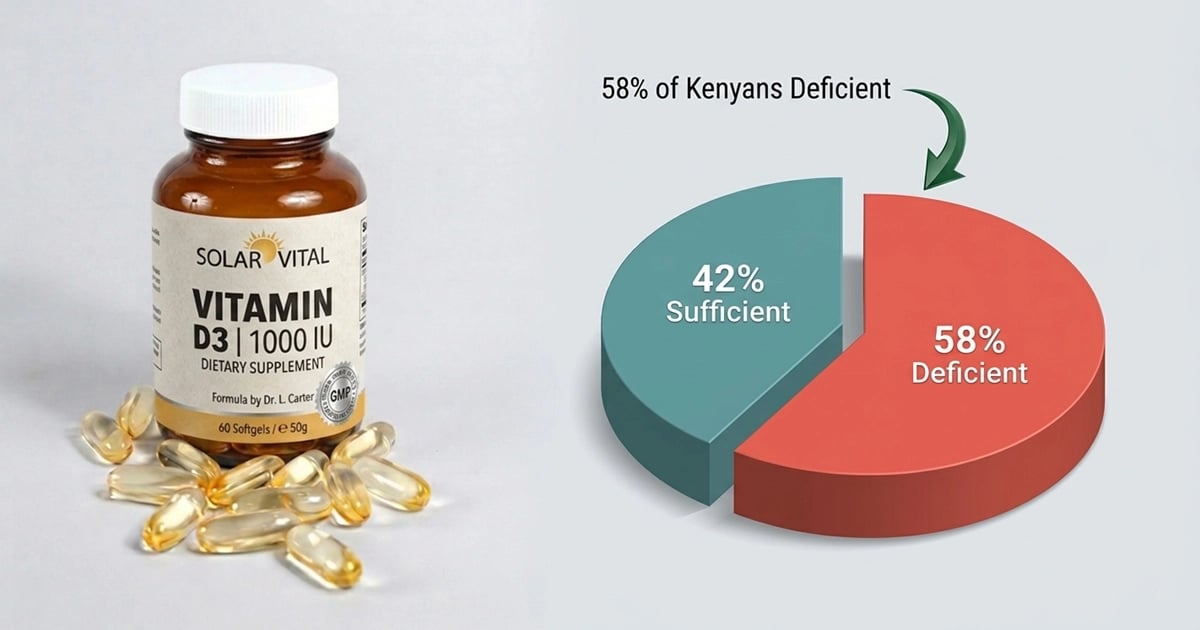
More than half of Sub-Saharan Africans, Kenyans included, are Vitamin D deficient, according to a meta-analysis by Mogire and colleagues published in The Lancet Global Health.
This might come as a surprise to many Kenyans, especially considering that Nairobi sits just over a degree south of the Equator. In fact, Nairobi is one of the few major cities at or very close to the Equator, sitting at just 1° 17' S.
At our location, with 25-40% of your body exposed at noon, you should be able to get your daily dose of Vitamin D in 15-30 minutes; however, considering occasional cloud cover, treat that window as a starting point rather than a guarantee.
But despite how easy it seems, deficiency among Nairobians remains stubbornly widespread. The issue can partly be attributed to the assumption that Vitamin D deficiency is a "Western" problem, something that happens to people with winters and snow, not us.
While living near the equator does make Vitamin D more accessible, many Nairobians rarely spend time outdoors during peak sunlight hours.
Darker skin also requires more sun exposure to produce the same amount of Vitamin D, meaning the little incidental sun exposure most of us get while commuting to work, lunch, or gym is barely enough.
Prevalence in Nairobi
The scale of the issue in Nairobi is evidenced by a study conducted at Aga Khan University Hospital, Nairobi, involving 258 healthy blood donors, which revealed that 42.6% were Vitamin D insufficient.
Another study conducted at Kenyatta National Hospital found that 30.5% of expectant mothers had suboptimal Vitamin D levels, with the researcher, Dr. Atandi, arguing that it was a direct predictor of deficiency in their newborns.
This issue is so significant that cases of nutritional rickets have been documented in the city. A case-control study in an informal Nairobi settlement found that 71% of children with rickets had Vitamin D levels below 30 nmol/L.
While rickets is an extreme manifestation seen primarily in malnourished children in informal settlements, the underlying bone weakening, osteomalacia, affects adults across all income levels.
Why You Should Care
Vitamin D, specifically D3, is one of the most important micronutrients in the human body, and for anyone serious about fitness, it is non-negotiable.
Low Vitamin D levels are inversely correlated with BMI and body fat mass, according to reviews published in Nutrients and the International Journal of Molecular Sciences, meaning the less Vitamin D you have, the more fat your body tends to accumulate.
It means that if you are trying to lose weight, a lack of Vitamin D could literally be the reason you are not seeing results.
Your performance in fitness activities like cycling, marathons, or lifting weights is also severely affected by a lack of Vitamin D.
Because it functions more like a hormone than a traditional vitamin, nearly every cell in the body has Vitamin D receptors (VDR) that, when activated by Vitamin D3, promote muscle protein synthesis and calcium transport.
This is important because Vitamin D3 is essential for the growth and development of Type II (fast-twitch) muscle fibres, responsible for power, speed, and explosive strength. When levels are low, these fibres can atrophy, contributing to decreased power output and strength.
In fact, researchers found that Vitamin D3 supplementation increased muscle fibre size by 10% among subjects who were deficient in the micronutrient.
Testosterone is another hormone highly affected by Vitamin D3. Researchers have found that men with sufficient Vitamin D levels have significantly higher free testosterone and lower levels of Sex Hormone-Binding Globulin (SHBG) compared to those who are deficient.
Higher free testosterone is the primary driver of muscle hypertrophy and mental focus in the gym. Without adequate Vitamin D3, your hormonal environment may be tilted towards catabolism (muscle breakdown) rather than anabolism (muscle growth), a problem that affects both men and women.
Finally, Vitamin D plays a crucial role in recovery by modulating the immune system and reducing systemic inflammation. Specifically, it reduces the biomarkers of muscle damage and inflammation following intense exercise.
This means that someone with optimal Vitamin D levels can recover more quickly than someone who is deficient, allowing for greater training frequency and better long-term physical progress.
What Can You Do?
The easiest thing any of us can do is simply spend more time in the sun. As mentioned earlier, 15-30 minutes of midday sun exposure is enough to get your daily dose; if you have a darker skin tone, aim closer to 30 minutes.
Going out only on weekends, while better than nothing, is not enough to maintain optimal levels.
When getting outside is not possible, a Vitamin D3 supplement is your next best option. It is one of the most affordable supplements available, and D3 specifically is the form your body uses most efficiently.
You can also get Vitamin D from food. Oily fish like salmon, cod, and even canned tuna are among the best dietary sources, as are egg yolks and beef liver.
However, the amount of Vitamin D you actually get from food varies significantly depending on the source.
Local eggs, for example, have been found to contain lower levels than expected, according to data from the Kenya Food Composition Tables available on our food tracker.
For this reason, food alone is rarely sufficient. Your most reliable options remain midday sun exposure and supplementation, ideally both.
What Are the Symptoms of Vitamin D Deficiency?
According to Yale Medicine, most people who are deficient in Vitamin D do not notice any symptoms.
However, some may experience muscle and bone pain, increased sensitivity to pain, a tingling sensation in the hands and feet, and muscle twitches or spasms.
"Possible symptoms include increased sensitivity to pain, a tingling sensation in the hands and feet, and muscle twitches or spasms"
Yale Medicine
If you suspect you are deficient, the best course of action is to visit a doctor for a proper assessment. Symptoms of Vitamin D deficiency often overlap with those of other conditions, making self-diagnosis unreliable.
Medical Disclaimer: The information provided in this article is for informational purposes only. It does not constitute medical advice, diagnosis, or treatment. Always seek the advice of your physician or other qualified health provider regarding any questions about a medical condition or substance use.



Join the conversation!
Share your thoughts on “You Are Probably Vitamin D Deficient if You Live in Nairobi” below.